
Judge Hogan, on the record: "I accept your argument that his due process rights were violated."
By Ryan Nichols
- 1.1K total reach
- 0 reading now•1 active 24h
- 0 shares•542 inbound
- 0 comments
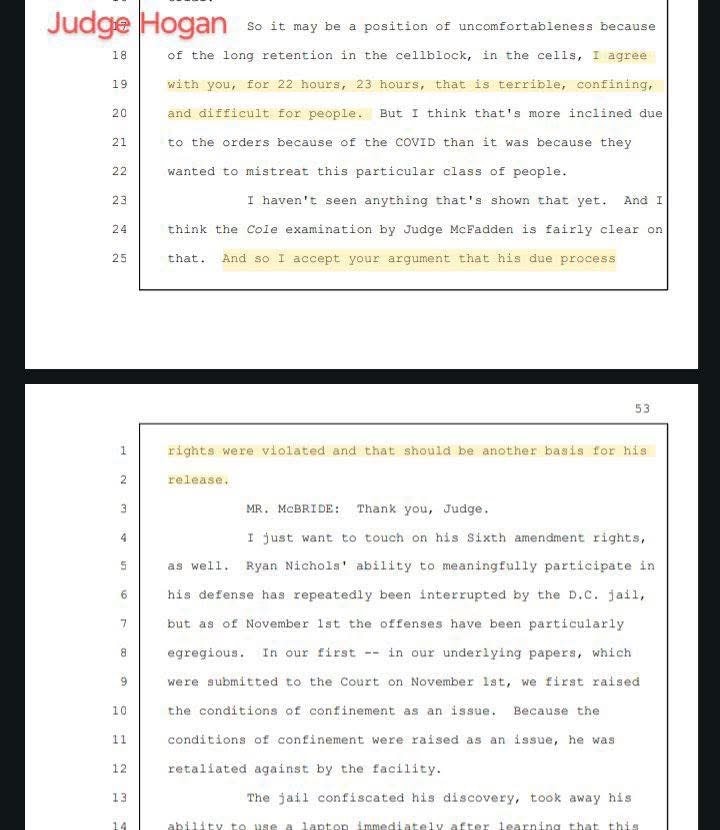
A senior federal judge looked at how I was being held before any trial, called it "terrible," and said — out loud, on the record — that my due process rights had been violated. Then I went back to my cell and stayed there.
That is not my characterization of the hearing. It is the transcript — printed above, and typed out word-for-word below so it can never be cropped, screenshotted out of context, or quietly deleted.
But before I show you what the court admitted, you should know who it happened to.
Who I was before any of this
I am a United States Marine Corps veteran. I built a company from the ground up — Wholesale Universe, Inc., a multi-million-dollar wholesale and retail operation. I trained and served in Texas Search and Rescue — the people who move toward the flood and the rubble when everyone else is moving away from it. I am a father.
I don't tell you that to brag. I tell you because I need you to feel the distance between the man who walked into the federal system and the man who walked out. I was productive. I was steady. I could carry weight — physical, mental, financial — and I did, for other people, for years.
Hold that picture of me. Because the system did not.
The hearing
December 2021. United States District Court for the District of Columbia. United States v. Nichols. A bond hearing — my argument for release from pretrial detention. Not post-conviction. Not post-trial. I was being held before a jury had heard a single thing, presumed innocent the way the Constitution says every American is.
The judge was the Honorable Thomas F. Hogan — and that matters. Hogan has sat on the federal bench since 1982 and served as Chief Judge of the D.C. District Court. When a judge of that seniority speaks from the bench, it is about as close to the considered voice of the federal judiciary as you will get.
Here is what he said. Verbatim:
"So it may be a position of uncomfortableness because of the long retention in the cellblock, in the cells, I agree with you, for 22 hours, 23 hours, that is terrible, confining, and difficult for people. But I think that's more inclined due to the orders because of the COVID than it was because they wanted to mistreat this particular class of people. I haven't seen anything that's shown that yet. And I think the Cole examination by Judge McFadden is fairly clear on that. And so I accept your argument that his due process rights were violated and that should be another basis for his release."
Read it again, slowly
Three things happen in that paragraph, and every one of them matters.
One — he admitted the conditions. Twenty-two, twenty-three hours a day locked in a cell. The judge's own words: "terrible, confining, and difficult for people." That is not my grievance being entered into the record. That is the court agreeing with it, in its own voice.
Two — he reached for the COVID explanation. He suggested the lockdown was "due to the orders because of the COVID" rather than a deliberate effort to "mistreat this particular class of people" — and this particular class of people meant January 6 pretrial detainees. Notice exactly what he said about proof of intent: "I haven't seen anything that's shown that yet." Not that it didn't happen. That he hadn't been shown it yet.
Three — and this is the one — he conceded the violation. "I accept your argument that his due process rights were violated and that should be another basis for his release." A federal judge, on the record, accepted that my constitutional due process rights had been violated, and said that was a reason I should be let out.
Then I stayed in
Say it as plainly as it deserves: the court acknowledged a constitutional violation against me, named it as grounds for release — and I was not released.
A right that is violated with no remedy is not a right. It is a courtesy the government extends when it's convenient and withdraws when it isn't. In December 2021 a federal judge said mine had been violated. I went back to the block. 22, 23 hours a day. Over the pretrial stretch I was moved through ten facilities — the full ledger, with dates, is on the case page.
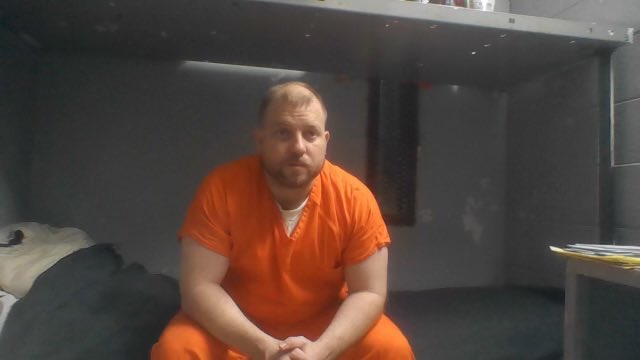
Inside the D.C. Jail during the pretrial period of United States v. Nichols — presumed innocent, convicted of nothing, held 22–23 hours a day in the conditions Judge Hogan called "terrible."
I had not been convicted of anything
People need to sit with what "pretrial detainee" actually means, because it changes everything about this.
I had not been convicted. Not of a single charge. I was being held before trial — which means, under the Constitution, I could not lawfully be punished at all. That is not my opinion; it is settled Supreme Court law. In Bell v. Wolfish (1979) the Court held that a pretrial detainee may not be subjected to conditions that amount to punishment, precisely because guilt has not been determined. You are still presumed innocent. The government's only legitimate interest is making sure you come back to court — not making you suffer.
Here is the distinction almost nobody is taught:
- The Eighth Amendment — "cruel and unusual punishment" — is the standard for people who have already been convicted. It is the floor for how the state may treat a prisoner it is lawfully punishing.
- A pretrial detainee is protected by the Due Process Clause, and that standard is more protective, not less. The government cannot impose punishment on a person it has not convicted — full stop. The question isn't "was it cruel and unusual." The question is "was it punishment at all."
That is exactly why Judge Hogan framed it as a due process violation. He reached for the right clause. I was a pretrial detainee, and he said on the record that my due process rights were violated.
Now follow it all the way down. If the conditions I was held in were severe enough to even approach the Eighth Amendment line — the line drawn for convicted prisoners — then for a man convicted of nothing, that is not a smaller problem. It is a far bigger one. They imposed punishment-grade conditions on someone the Constitution says could not be punished at all. Twenty-two, twenty-three hours a day. On a presumed-innocent man. And a federal judge agreed it was wrong — and it continued anyway.
What it did to me
Here is the part the transcript doesn't show.
You do not spend that long, in those conditions, and come out the same person. I didn't. I want to be honest about it in public, on the record, because hiding it is exactly what the people who did this are counting on.
My mind does not work the way it used to. Before, I could run a company, hold a hundred moving details in my head, make fast decisions under real pressure. Now there are days a single page takes me three passes to get through. I lose the thread of my own sentences. My focus breaks. My sleep breaks. The steadiness I built an entire life on is not where I left it.
I am not the same, and I am not going to pretend I am to keep anyone comfortable. They damaged me — psychologically and cognitively, in ways I am still measuring. That is the real cost behind "22, 23 hours a day," the cost a federal judge called "terrible" and then sent me back into.
Where that leaves me now
The plain truth: I cannot work the way I used to. The man who could carry the weight can't carry it the same way right now. The company, the income, the steadiness — I am rebuilding all of it from a starting point well below zero, with a brain that is still healing.
I am pursuing what I am owed. Until that settlement comes through, I am stuck in the hard in-between — bills that do not care what was done to me, and an ability to earn that has not come all the way back.
So I am going to ask directly, the way I would want someone to ask me: if you are able, help me bridge the gap. You can donate right here, on this site. Every dollar goes straight to me — no organization, no middleman — and it does two things at once: it keeps my bills paid while I heal, and it buys me the time to keep doing this work — the investigations, the transcripts, the public record that no platform can throttle and no agency can delete.
And here is my pledge, the same one I have made everywhere on this site: the day my settlement comes through, the donation ask comes down. I am not building a tip jar for life. I am asking for a bridge across the gap they put me in.
Why I am putting this on the record
I am not asking you to take my word for any of it. That is the entire reason the transcript is here. This is the system describing — in its own voice, in its own certified document — a wrong it then chose not to fix.
Cases get pardoned. Charges get dismissed. Mine were: President Trump pardoned me on January 20, 2025, and my charges were dismissed with prejudice — meaning the case can never be brought against me again. But a pardon ends a prosecution. It does not erase a record, and it does not un-happen a single one of those hours. What was done still happened. The men who lived it are still here. This transcript is one exhibit of many.
That is why this site exists — to keep the receipts in public, on a domain no platform can throttle and no agency can take down. The DOJ already tried to erase its own master record of every January 6 defendant. I salvaged it. I am not going to let the rest go quietly either.
- 📂 The full case file — United States v. Nichols
- 🗂️ Evidence the DOJ tried to erase
- 🤝 Stand with me — how to help
The verse that carried me through it
"You meant evil against me, but God meant it for good, to bring it about that many people should be kept alive." — Genesis 50:20
They meant it for evil. I am going to use it — the time, the transcripts, the skills, the platform no one can ban me from — to build a record so complete that the next person they try this on walks in already holding the receipts.
The trap they set keeps becoming the launchpad.
— Ryan
Fighting Shadows · Pre-order
Early access for $17.76$29.9941% off
Read it first and own a piece of the story — or become a Founding Supporter (limited to 250).
Don't lose this story to an algorithm.
The next chapter gets posted here first — on my own domain, where no platform can throttle it and no one can ban it. Drop your email or number and the update reaches you the moment it's live.
Email gets one confirmation click. Unsubscribe anytime. No spam, no selling your data — ever.
Tap how this hits you — no signup, everyone sees the count
Share this post — get it back in front of people
Read next
From the case file
United States v. Nichols — the case
Timeline, people, documents — the whole file
From the case file
The document archive
Every public scan, sourced and labeled
They Say the Pipe Bomb Case Is Solved. I'm Still Waiting on Justice.
This Is Called Moving On
Mitch McConnell Must Retire. Immediately.
The Kind of Man My Kids Need Me to Be
Comments
Speak here
Create an account to comment.
This is where people can say what gets buried or cancelled elsewhere. Comments are signed-only, moderated, and tied to a real profile so the record stays usable.
No approved comments yet. Create an account and put the first opinion on the record.